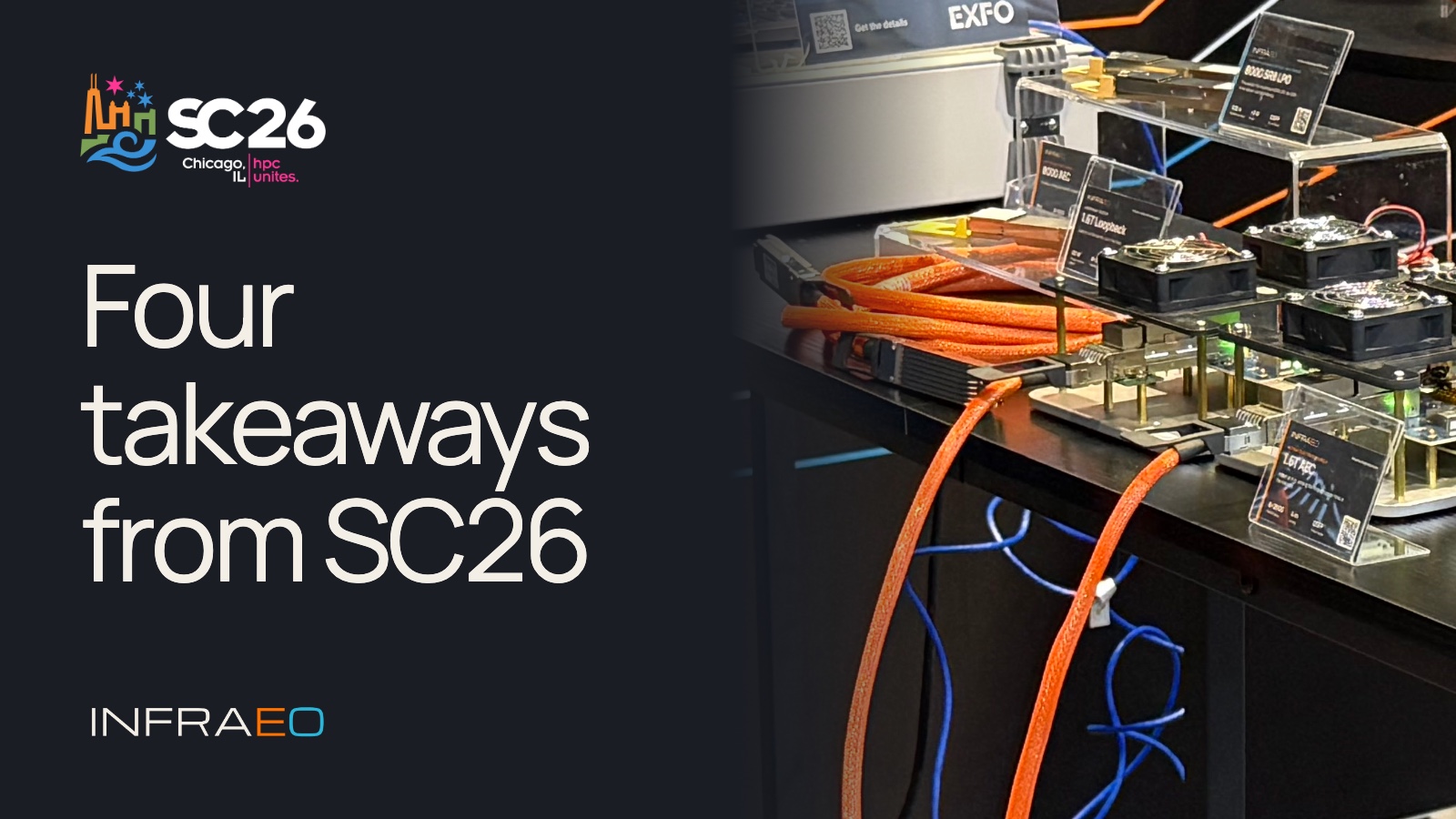
SC26 wrapped up on November 20 in Chicago under the theme "HPC Unites," with reported attendance of more than 24,000 people and 595 exhibitors [1]. We spent the week at Booth 5617 showing our copper and optics and walking the floor. Here are four things that stood out.
1. Power is now the limit, so performance per watt matters more than ever.
Power was one of the clearest themes at SC26. There are hard limits on how much data center capacity can be built and powered, so performance per watt matters more than ever. Buyers are responding by "right-sizing": choosing the CPUs, accelerators and memory that fit the job instead of the biggest machine available. Analyst firm Futurum built its SC26 recap around this idea [2].
Power and heat go hand in hand. Nearly every watt a system draws ends up as heat that has to be removed, so higher power means higher temperatures and more cooling, which takes power of its own. It showed in the news from the week: NVIDIA announced a fully liquid-cooled rack of 192 Vera CPUs with about 300 TB of memory, aimed at scientific workloads [3], and cooling suppliers such as nVent [4] and Delta showcased liquid cooling for AI racks, with Delta showing a coolant distribution unit rated at 2.5 megawatts [5].
The same logic applies to the interconnects between systems. When the power budget is fixed, every watt spent moving data is a watt not spent on compute. That is the idea behind LPO (linear pluggable optics): our 800G LPO drops the DSP entirely. Industry estimates put a DSP-based 800G module at roughly 14 to 17 watts and an LPO module at roughly 7 to 9 watts, a saving of around 40 to 50 percent per link [6]. Every watt saved is also heat that does not have to be cooled, and across thousands of links, that adds up quickly.
2. The bottleneck is moving to memory and storage.
As GPUs and CPUs get faster, the bottleneck is increasingly getting data to them. That made memory and storage two of the most visible themes at SC26.
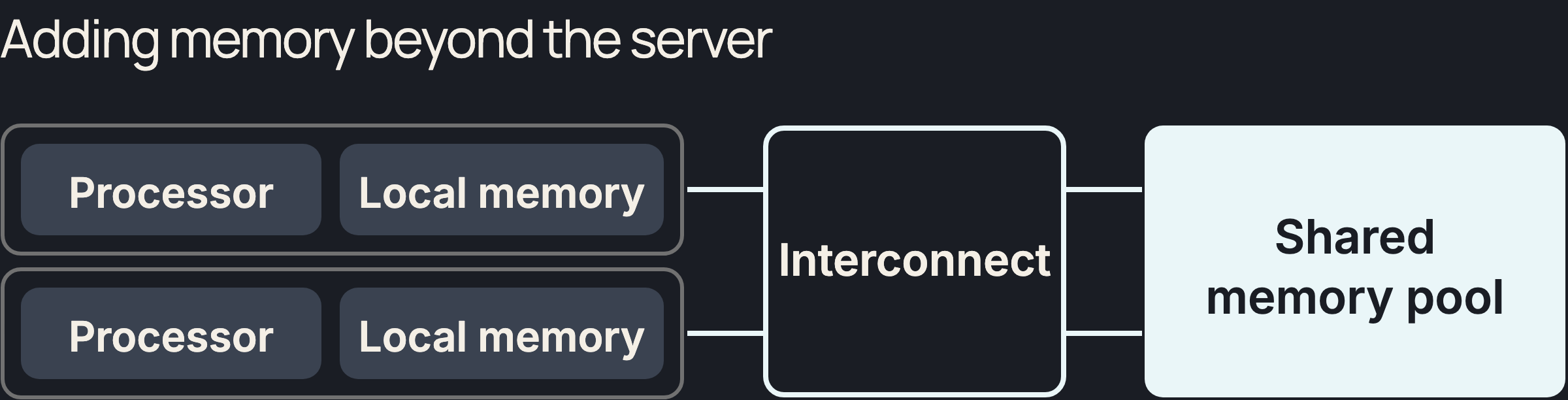
On memory, the push is to give AI models more fast memory than fits in a single server. SK hynix presented a memory-centric rack that keeps the data a model needs soonest in high-speed memory and moves the rest into a shared pool [7]. Penguin Solutions, working with Marvell, showed an appliance that connects up to 576 GB of high-bandwidth memory and 16 TB of conventional memory to processors over optical links, with customer samples expected in late 2027 [8].
On storage, vendors focused on serving AI jobs directly. MinIO announced general availability of AIStor Memory, which gives AI agents long-term memory and persistent workspaces [9], and VAST Data previewed a feature that lets schedulers and administrators control shared storage performance job by job [10].
The common thread: memory and storage are moving out of the single server and into shared pools across the rack, which means more data crossing more connections.
3. AI agents are showing up across the AI stack.
AI agents were all over the show floor, from verifying clusters to tuning code to optimizing storage. The bigger shift is agents being built into scientific computing itself. NVIDIA opened its SC26 week with tools for agents that plan experiments, run code and check results on researchers' own systems [11], including an open model and a dataset of nearly 50,000 questions for training and evaluating models on chemistry reasoning [12]. Ahead of the show, Google Cloud introduced reusable agent "skills" for building and running HPC workloads, using tested tools and pausing for human approval before deployment [13]. MiTAC showed infrastructure for running very large models on-premises [14], and SC26 included its first workshop dedicated to agentic AI for HPC [15].
For infrastructure, the key point is that agents do not ask one question and stop. They work in loops, calling models and tools over and over, often around the clock. That turns AI from a burst of training into a constant load, with steady traffic between processors, memory and storage.
4. Quantum processors are joining CPUs and GPUs.
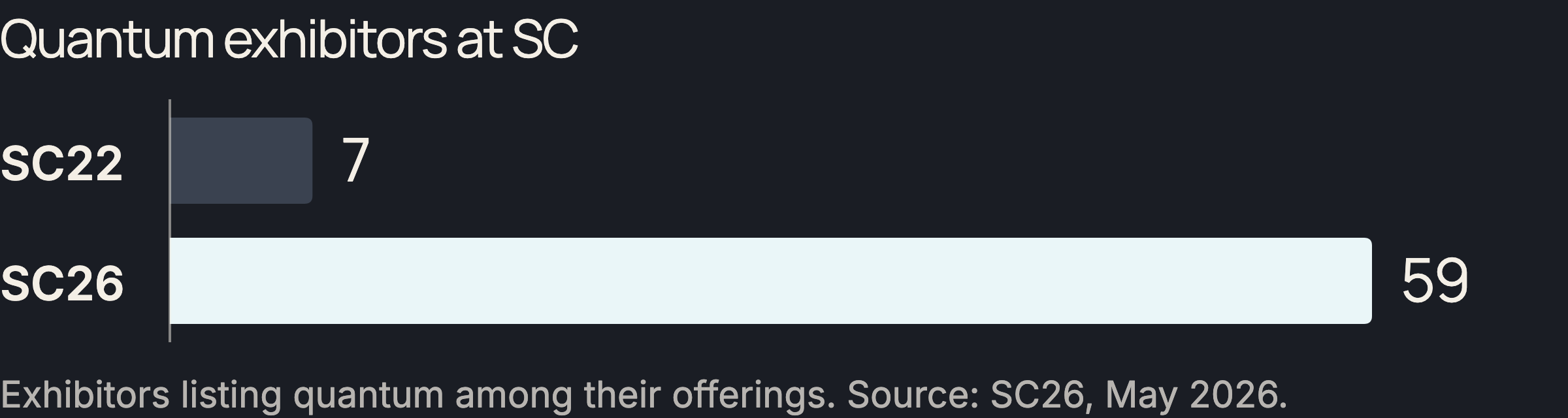
Quantum had its own area on the floor this year, and SC26 counted 59 quantum exhibitors, up from seven at SC22 [16]. More telling than the count was the pitch: quantum is increasingly presented not as a replacement for classical computing, but as another accelerator alongside CPUs and GPUs [17]. NVIDIA announced that version 26.11 of Slurm, a widely used HPC job scheduler, adds a way to schedule quantum processors as part of the workflows centers already run, and named IBM, IQM, Pasqal and Quantinuum among those adopting it [18]. Some of that work is still at the demonstration stage. Separately, a group including LuxQuanta and Ciena demonstrated a quantum-safe network at SC26 linking Chicago, Amsterdam and the Bilbao area [19].
What ties it together
Put side by side, the four themes describe one picture: more data moving between more types of machines, all the time, within a fixed power budget. Every one of those connections has to be fast, reliable and efficient. That is where Infraeo's copper and optics expertise comes in, at every reach.
Thank you to everyone who stopped by Booth 5617. If you are planning your next build, talk to one of our engineers.
References
1. SC26 attendance: GÉANT, "Supercomputing SC26: when classical computing, quantum technologies and AI come together". https://connect.geant.org/2026/11/23/supercomputing-sc26-when-classical-computing-quantum-technologies-and-ai-come-together
2. Futurum, "SC26: Supercomputing 2026 Shows AI for Science Will Run on Right-Sized Compute". https://futurumgroup.com/insights/sc26-supercomputing-2026-shows-ai-for-science-will-run-on-right-sized-compute/
3. NVIDIA, "NVIDIA Expands Vera CPU Platform to Accelerate Scientific Discovery". https://nvidianews.nvidia.com/news/nvidia-expands-vera-cpu-platform-to-accelerate-scientific-discovery
4. nVent, "nVent Features Expanded Liquid Cooling and Power Portfolio at SC26". https://investors.nvent.com/press-releases/press-release-details/2026/nVent-Features-Expanded-Liquid-Cooling-and-Power-Portfolio-at-SC26/default.aspx
5. Delta Electronics release, AI data center cooling solutions at SC26, via HPCwire. https://www.hpcwire.com/off-the-wire/delta-electronics-showcases-ai-data-center-cooling-solutions-at-sc26/
6. LPO and DSP power estimates: Ascent Optics, "800G Power Consumption: Watts by Module, pJ/bit, and LPO Savings". https://ascentoptics.com/blog/800g-power-consumption/
7. SK hynix, "Building the Future AI Ecosystem Around Memory". https://news.skhynix.com/en/sc26-ai-hpc-exhibition/
8. Penguin Solutions release, photonic appliance for shared CPU and GPU memory, via HPCwire. https://www.hpcwire.com/off-the-wire/penguin-solutions-unveils-photonic-appliance-for-shared-cpu-and-gpu-memory-at-sc26/
9. MinIO release, AIStor Memory, via StorageNewsletter. https://www.storagenewsletter.com/2026/11/20/sc26-minio-marks-two-years-of-aistor-with-innovation-enterprise-ai-momentum-and-global-partnerships/
10. VAST Data release, Job-Level Quality of Service at SC26, via HPCwire. https://www.hpcwire.com/off-the-wire/vast-data-previews-job-level-quality-of-service-at-sc26/
11. NVIDIA, "Ian Buck Kicks Off NVIDIA's Week at SC26 as Science Enters the Age of Agents". https://blogs.nvidia.com/blog/ian-buck-sc26/
12. NVIDIA, Nemotron for Science announcement. https://nvidianews.nvidia.com/news/nvidia-introduces-nemotron-for-science-to-accelerate-discoveries-with-agents
13. Google Cloud, "Where supercomputing meets agentic AI: What's new in Google Cloud HPC and AI at SC26". https://cloud.google.com/blog/topics/hpc/whats-new-in-hpc-and-ai-at-sc26
14. MiTAC Computing release, agentic AI infrastructure at SC26, via HPCwire. https://www.hpcwire.com/off-the-wire/mitac-computing-scales-agentic-ai-with-full-stack-infrastructure-at-sc26/
15. SC26, "A 'Gold' Standard: SC26 Welcomes 50 Workshops to Chicago". https://sc26.supercomputing.org/2026/04/a-gold-standard-sc26-welcomes-50-workshops-to-chicago/
16. SC26, "SC26 Welcomes First-Time Exhibitors to Chicago" (quantum exhibitor count). https://sc26.supercomputing.org/2026/05/sc26-welcomes-first-time-exhibitors-to-chicago/
17. IBM, "SC26: IBM shows progress in bringing quantum and HPC together". https://www.ibm.com/quantum/blog/sc26
18. NVIDIA, "NVIDIA Expands Slurm to Bring Quantum Computing Into Supercomputing". https://blogs.nvidia.com/blog/slurm-quantum-computing-supercomputing
19. LuxQuanta, hybrid quantum-safe networking across 8,000 km. https://luxquanta.com/resources/luxquanta-collaborates-in-hybrid-quantum-safe-high-speed-networking-across-8000-km-connects-us-and-europe-with-an-adaptive-cryptoagile-solution/
Comments
No comments yet. Be the first to share your thoughts.